Why ceiling height changes the way a room feels
Two apartments. Same square footage. Same furniture budget. You walk into the first one and something in your chest loosens. You walk into the second and you feel like you're sitting in a shoebox. Nothing about the floor plan explains it. The difference is vertical, and most people underestimate how much of a room's personality lives above eye level.
I learned this the hard way. My first renovation was a 1930s flat with a living room ceiling at 2.35 meters. I painted it white, put in a sofa, hung a mirror, called it done. It still felt cramped. Later I moved into a place with 3.1-meter ceilings and did almost nothing to it. People walked in and said "wow, this is spacious." Same amount of effort. Completely different reaction. That's when I started paying attention to what's actually happening overhead.
Key Takeaways
- Ceiling height is one of the strongest drivers of how a room feels, and it operates independently of floor area.
- Below roughly 2.40 m, a room starts to press down on you. Above 2.70 m, it starts to open up. The sweet spot for most living spaces sits around 2.60 to 3.00 m.
- You can't raise a ceiling cheaply, but you can change how high it reads—with color, light, window treatment, and furniture scale.
- High ceilings are not automatically better. They cost more to heat, they amplify sound, and they can make a room feel impersonal if you don't fill the vertical space.
- What looks like a moving ceiling is usually a perceptual quirk, not a structural one. It's called the autokinetic effect.
What makes a ceiling feel higher
The number in the listing matters less than you'd think. A 2.50-meter ceiling with a tall window and pale walls reads taller than a 2.70-meter ceiling with a low-hung pendant lamp and dark trim. Perception is doing the work, and perception follows a handful of predictable cues.
The horizontal line your eye locks onto
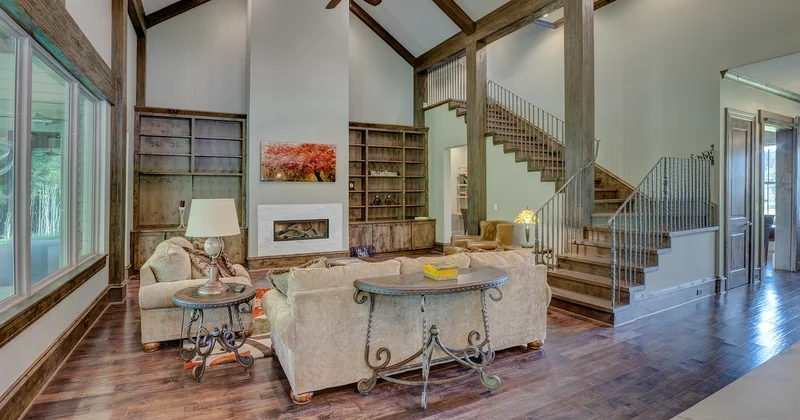
Your brain doesn't measure the ceiling directly. It measures the distance between the highest horizontal line you can see and the ceiling itself. That line might be a window head, a door frame, a picture rail, or the top of a bookshelf. The bigger the gap, the taller the ceiling feels.
Which explains a counterintuitive trick: lowering a door frame can make a ceiling feel higher, because you've pushed the visual reference point down. I tried this in a hallway once—dropped the door head by 12 cm—and two separate visitors asked whether I'd raised the ceiling. I hadn't touched it.
Light from above and light from the side
Washed light on a vertical surface pulls the ceiling visually upward. That's why uplighting works so well, and why a bare bulb on a cord does the opposite—it creates a bright blob near the ceiling and kills the sense of volume. Floor-to-ceiling curtains hung right at the ceiling line do the same job as uplighting, and they cost less.
Vertical proportions matter too. A room that's 4 meters wide with a 2.40-meter ceiling has a width-to-height ratio of about 1.7:1. That's a rectangle lying on its side: it reads as low and wide. Push that ratio toward 1.2:1 and the same room suddenly feels balanced.
Color and the visual weight of the ceiling
A white ceiling reflects roughly 80 to 90 percent of the light that hits it. A medium gray one reflects closer to 50. Dark ceilings absorb, and absorption flattens the sense of distance. If you want height, keep the ceiling lighter than the walls. If you deliberately want a room to feel grounded and intimate—a dining nook, a reading corner—a darker ceiling is a legitimate move, not a mistake.
Why does the ceiling look like it's moving?
It's not your ceiling. It's your visual system filling in the blanks. When you stare at a blank, uniform surface with no fixed reference point—a flat white ceiling at night, a featureless wall—your eyes make tiny involuntary movements that your brain can't quite cancel out. The result is an illusion of slow drift or pulsing. Psychologists call it the autokinetic effect, and it's been documented for well over a century.

Add a slow-moving shadow—from a passing car, a tree outside a window, a swaying pendant lamp—and the effect gets stronger. Some people also perceive it when they're tired, dehydrated, or lying flat and staring upward, which is why it's most often reported in bedrooms at night.
There's a second, rarer cause worth knowing about. If a ceiling genuinely appears to ripple or move only in one area, particularly in an older house, it can be sagging plasterboard, a water leak above, or seasonal timber movement. That's a structural question, not a perceptual one. If the movement tracks with your head position, it's almost certainly your eyes. If it doesn't—get someone to look at it.
What is the ideal ceiling height for each room in a house?
There's no single correct number, but there is a sensible range per room, and it shifts depending on what you do in the space. Here's how I'd map it after working through renovations in flats, a farmhouse, and one very badly designed new build.

| Room | Comfortable range | Why |
|---|---|---|
| Bedroom | 2.40–2.70 m | Sleep benefits from enclosure. Very tall bedrooms can feel exposed and echo badly. |
| Living room | 2.60–3.20 m | Enough height for a sense of openness without losing intimacy. |
| Kitchen | 2.40–2.80 m | Extraction, cabinetry reach, and lighting are all easier to solve in this band. |
| Bathroom | 2.30–2.60 m | Low is fine here. Warmth retention matters more than drama. |
| Hallway or entry | 2.40–3.50 m+ | Compression on entry, release into the main space, works well. |
| Dining or double-height space | 3.50 m and up | Gathering spaces carry the extra volume without feeling empty. |
Two caveats. First, these are comfort ranges, not regulations—building codes in most countries set a legal minimum around 2.20 to 2.40 m for habitable rooms, which is a floor, not a target. Second, older housing stock often sits at 2.70 to 3.20 m precisely because it predates cheap heating; the ceilings were built for airflow, not for thermal efficiency.
One habit that helps: if you're buying or renting, measure the ceilings yourself before you sign anything. Agents round generously. I once viewed a "high-ceilinged" flat that measured 2.42 m in the living room. A laser measure costs less than a takeaway dinner and it has saved me from two bad decisions.
What are the disadvantages of having a high ceiling?
High ceilings are treated as a universal good in property listings. They aren't. The trade-offs are real, and they show up in places the photographs don't capture.
- Heating. Warm air rises, and a 4-meter ceiling gives it a long way to go before you notice. My heating bill in a double-height living room ran about 25 percent higher than in a comparable flat with standard ceilings. Ceiling fans on reverse help. They don't erase the gap.
- Sound. Hard, tall surfaces reflect. A room with a 4-meter ceiling and tile or wood floors can turn a normal conversation into a small amphitheater. Rugs, soft furnishings, and anything with texture on the walls make a bigger difference than people expect.
- Maintenance and cleaning. Changing a bulb becomes a ladder job. Painting a 4-meter wall is a two-day project. Cobwebs form where you can't see them and where you can't reach them.
- Lighting cost. High ceilings demand more fixtures and stronger output to feel evenly lit. A single pendant doesn't cut it.
- Emptiness. Volume without scale is just air. A high ceiling in a room with low furniture and bare walls reads cold and unanchored, not grand.
The last one is the one people underestimate most. Proportion matters more than raw height. A 2.70-meter ceiling in a 3-meter-wide room feels generous. The same height in a 6-meter-wide room feels flat, because the width overwhelms it.
Can you fix a ceiling that feels too low?
Yes, within limits. You can't add volume without knocking down structure, but you can change almost every visual cue your brain uses to judge it.
Practical changes, ordered by impact
- Paint the ceiling the same tone as the walls, or lighter. The boundary line disappears and the room reads taller.
- Hang curtains at the ceiling line, not at the window head. This is the single cheapest fix with the biggest visible effect.
- Replace a central pendant with recessed or wall-washed lighting so nothing hangs into the visual field.
- Choose furniture with legs—sofas raised off the floor, side tables with visible frames. Floor-to-ceiling upholstery visually shortens a room.
- Use vertical elements: tall bookshelves, vertical paneling, floor-length mirrors.
- Remove any horizontal banding across the middle of a wall—chair rails, dado lines, wallpaper borders. They cut the room in half.
The one thing I'd avoid: painting the ceiling dark in a genuinely small room hoping it looks moody. In a low-ceilinged space it usually reads as heavy and closes the room in further. Save that move for rooms that already have height to spare.
The part most people miss
Ceiling height isn't a luxury feature you either have or don't. It's a variable you're constantly negotiating with—through color, light, furniture, and the lines you let your eye follow. A 2.40-meter ceiling handled well beats a 3.20-meter ceiling handled badly, every time. I've seen both in the same week, and the difference had nothing to do with the tape measure.
Next time you walk into a room and can't quite say why it feels right—look up. The answer is usually somewhere between your eyeline and the ceiling, in the gap your brain quietly measured before you'd even taken off your coat.