Why your home feels dark even when the lights are on
You flick the switch, the ceiling light blazes, and the room still looks like a waiting area at dusk. Nothing is broken. Nothing is dimmed. And yet the space feels heavy, flat, closed in.
I've been through this in two apartments. The first one had a single pendant in the middle of a 22 m² living room, and I spent eight months convinced the place was simply badly oriented. Then I moved the light source, changed two bulbs, and the same room suddenly read as bright. Same windows. Same furniture. Same paint. The problem was never the quantity of light. It was where the light landed and what it hit on the way down.
That distinction matters, because "my home feels dark" covers two completely different problems, and mixing them up wastes money.
Key Takeaways
- Most dark-feeling rooms are not under-lit. They are lit from one direction, which flattens everything below eye level.
- Flickering or pulsing lights are usually an electrical or compatibility problem, not a design one.
- The three-layer rule (ambient, task, accent) works because it removes shadows rather than adding brightness.
- Color temperature in Kelvin changes perceived brightness more than wattage does.
- Dark fabrics, matte walls and one-directional light absorb what you paid for.
- Before buying new fixtures, audit one room for twenty minutes with the lights you already own.
Two kinds of dark: design problem vs electrical problem
Before you buy anything, work out which one you have. The symptoms are not the same and the fixes have nothing in common.

What could be causing my house lights to dim?
If your lights actually change intensity, dip when the fridge kicks in, or flicker at low settings, you're looking at an electrical issue rather than a lighting design one. The usual suspects are voltage drop on a long run of undersized cable, a circuit loaded close to its limit, a loose neutral connection in a switch box, or an LED bulb that simply isn't compatible with the dimmer installed.
That last one catches people constantly. Dimmable LEDs exist in several driver generations, and an older leading-edge dimmer paired with a modern bulb produces buzzing, strobing or a narrow usable range where the light either sits near full brightness or cuts out. If the flicker started right after you swapped bulbs and nothing else changed, the bulb and the dimmer are the answer.
Anything involving heat at the switch plate, a burning smell, or lights that dim across several rooms at once needs an electrician. Do not troubleshoot that yourself. The rest you can test safely: move one bulb to a different fixture, check whether the dimming follows the bulb or stays with the room.
When the wiring is fine but the room still reads as dark
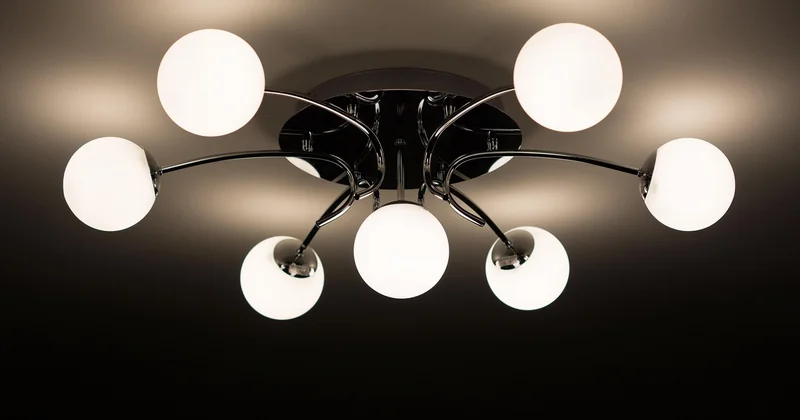
This is the more common case, and it's almost always about light placement. A single ceiling fixture sends light straight down and straight out. It illuminates the table. It does not illuminate the wall behind you, the ceiling, the corners, or your own face when you're reading. Your eye judges brightness largely by what bounces back off vertical surfaces, so a room with a bright floor and dark walls around eye level will always feel dim no matter how many lumens you throw at it.
Look, three years ago I made exactly this mistake in a bedroom. I upsized the ceiling fixture from roughly 800 to 1600 lumens. The room got harsher, not brighter. Shadows under the bed and in both corners became sharper. That's the tell.
How to make a dark room feel like it has natural light
Natural light has three properties that artificial light rarely copies: it comes from the side, it's diffuse, and it arrives at a high color temperature during the day. Copy those three and a north-facing room with one small window stops feeling like a cave.

Start with direction. Move your main source off the ceiling center and toward the wall opposite your seating. A floor lamp angled up into a corner bounces light onto two surfaces at once and lifts the whole perceived brightness of the room. I did this in a 14 m² office and the difference was noticeable within a day.
- Angle one fixture upward so it grazes the ceiling. Ceilings act as giant reflectors if you let them.
- Add a second source at eye level so faces and tabletops get lit from the front, not from above.
- Swap dark furniture near the window. A black sofa in front of the only window eats a surprising amount of daylight.
- Hang a mirror opposite the window, not beside it. Beside does almost nothing.
- Wash the window glass. It sounds trivial. It isn't.
Then handle color temperature. Body text in warm rooms can feel cozy at 2700 K, but if a room's job is to feel open during the day, 4000 K reads visibly brighter than 2700 K at identical output. Many bulbs now ship with a switchable range, so you can shift the same fixture from morning to evening without buying anything new.
What is the 3 lighting rule?
The three-layer rule says every room should carry three kinds of light: ambient light for overall illumination, task light where you actually work or read, and accent light for depth. It isn't a decorating opinion. It's a way of eliminating the shadows that make a room feel smaller than it is.
| Layer | What it does | Typical placement | Where people get it wrong |
|---|---|---|---|
| Ambient | Fills the room so you can move safely | Ceiling or a large pendant | Relying on it as the only layer |
| Task | Puts focused light on a surface | Desk, kitchen counter, reading chair | Placing it behind you instead of over the surface |
| Accent | Adds depth and highlights texture | Walls, shelves, artwork, corners | Skipping it because it feels optional |
Skip the third layer and you lose depth. Skip the second and you strain your eyes at 9 p.m. The first layer alone is what most rentals come with, and it's why so many apartments feel like hotel corridors.
How to fix poor lighting in a room: a twenty-minute audit
Pick one room. Turn everything on. Then walk the perimeter and ask a single question at each corner: is there anything here catching light? If three of four corners are dark, your ambient layer is doing all the work and your accent layer doesn't exist.
Then check the middle band of the room, roughly between your knees and your shoulders. That's where your eye spends most of its time, and it's the band a ceiling fixture ignores completely. A wall-mounted light, a low pendant over a side table, or even a lamp on a stack of books fixes it.
Measure, don't guess
You can estimate required output without a light meter. For a living area, somewhere between 10 and 20 lumens per square foot covers general use, and task zones want noticeably more concentrated on a small area rather than spread across the ceiling. A 20 m² room is roughly 215 square feet, so that's about 2,000 to 4,000 lumens total — split across three fixtures instead of dumped into one.
The mistake I see most often isn't the total. It's concentrating everything into a single source. Two 900-lumen fixtures placed at different heights will make a room feel brighter than one 2,400-lumen fixture, because the second one fills the shadow the first one created.
Quick diagnostic checklist
- Lights change intensity when appliances start? Electrical, call someone.
- Flicker only at low dimmer settings? Bulb and dimmer compatibility.
- Room bright at floor level, dark at eye level? Placement problem.
- Everything looks flat and shadowless in a bad way? You have ambient only.
- Walls look grey despite white paint? Color temperature too warm for the room's size.
The light you already own
Here's what I'd want someone to tell me before I spent money on fixtures: the room isn't dark because you lack light. It's dark because the light you have is hitting the wrong surfaces, at the wrong height, from a single direction.
Move one lamp tonight. Angle it at the ceiling. See whether the room changes before you buy anything.
If it does, you've found your answer — and it cost you nothing but the walk across the room.